Common holiday rental property manager mistakes to avoid
7 minute read // updated
 by Adam Aaron, Customer Support Lead
Key Takeaways
- Incomplete property listings and unlabelled photos are among the most common (and fixable) mistakes
- Knee-jerk reactions to bad reviews or slow months often make things significantly worse
- Treating dynamic pricing and AI tools as gospel, rather than a guide, leads to poor decisions
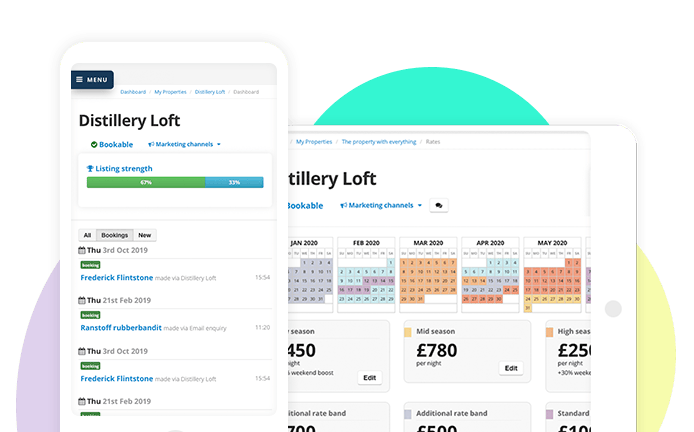
Every property manager makes mistakes - especially early on. But some of the most common ones come up again and again, regardless of experience level. In this post, Here are the patterns I see most often when onboarding and supporting holiday letting agencies and what to do differently.

1. Leaving property content incomplete
One of the most common issues is that property listings that simply aren't finished. Descriptions are thin, amenities aren't listed, and (most often) photos are uploaded without titles or descriptions attached.
It might seem like a minor detail, but unlabelled photos do real damage. If your image file is still called something like IMG_0484.jpg, that's what could show up on your Bookster website or on Airbnb. It looks unprofessional, and it actively harms your search visibility.
A photo of a hot tub labelled "Hot tub with views over Caithness" is a keyword-rich asset. Google can index it, guests can find it, and it helps convert browsers into bookers. The same photo with no title does none of those things.
There's also an accessibility angle. Screen readers (used by guests with visual impairments) rely on photo titles and alt text to describe images. And in a sense, search engines are blind too: proper labelling helps them index your content correctly.
The fix is straightforward and doesn't take long. Go into each property, check every photo, and add a descriptive title and short description. Think about what a guest searching for your property might type: and make sure those words appear.
2. Not trusting the onboarding process
My biggest frustration from the support side is clients who arrive at their onboarding session laser-focused on one specific detail: before the fundamentals are in place.
Onboarding follows a structured sequence and there are settings and configurations that need to be in place before the finer details make any sense. If your payment settings aren't correct, for example, and you're already asking what the guest confirmation email looks like: you're going to be shown an email with inaccurate payment information.
About 90% of those questions are answered during the onboarding process naturally.
The details follow from the foundation. Trying to tackle them in the wrong order creates confusion and wastes the session.
The advice is simple: trust the process. If you have a specific concern or edge case, flag it at the end. You'll be in a much better position to address it once the fundamentals are working correctly.
3. Knee-jerk reactions to bad experiences
This one comes up constantly. A property manager has a difficult guest, a frustrating support interaction with a booking channel, or a slow fortnight and they make a drastic decision in response.
Common knee-jerk reactions include:
- Pulling a listing offline after one bad review
- Abandoning a marketing channel (like Booking.com) after a single negative experience
- Cancelling a booking because the payment came in slightly lower than expected
- Creating a new listing to dodge a bad review (and then getting banned from the channel entirely)
Step back before acting. If you've received a bad review, respond to it thoughtfully rather than hiding or deleting the listing. Guests reading your reviews can usually tell when a review is unfair, especially if you have ten positive reviews alongside one awkward one. A calm, professional response demonstrates that you're on top of your property and care about your guests' experience.
Repeatedly toggling listings on and off, or creating new listings to escape negative feedback, will likely get you penalised by channel algorithms. Channels reward consistency and reliability. Erratic behaviour signals the opposite.
A rule of thumb: "Stop, breathe, think - then react." A measured response almost always produces a better outcome than an immediate one.
4. Expecting bookings before guests are ready to book
A related issue is impatience with booking volumes - particularly for properties listed with availability months in the future.
If you list a property in January with availability from July onwards, and you're checking for bookings in February, you're likely to be disappointed. That's not a sign something is broken - it reflects how guests actually book. Most people book four to eight weeks before their trip, not six months out.
The trend at Bookster has been towards later and later bookings over time. That doesn't mean last-minute, but it does mean that patience is genuinely part of the strategy. Pulling properties or switching channels because of a slow first couple of months may be exactly the wrong move.
5. Confusing Bookster (the software) with a full-service agency
Bookster is a property management software tool. It syncs your listings and prices across channels, runs your website, and processes bookings. Bookster is not a marketing agency or a consultancy.
Clients sometimes expect Bookster to proactively promote their properties, advise on pricing strategy, or make commercial decisions on their behalf. That's not what the software does and it's important to understand the distinction.
The team will always offer friendly guidance where they can. But ultimately, knowing what makes your property unique, what draws guests to your area, and what price the market will bear: that's knowledge only you have. The software gives you the infrastructure; the strategy is yours.
6. "PMS hopping" between platforms
Some property managers get into a cycle of switching between property management systems - moving to a new platform because it offers one feature they like, then leaving when they realise it doesn't replicate everything their previous software did.
Every platform involves trade-offs. No software does everything the way every user would ideally want. The question to ask before switching isn't "does this platform do X?" but "does this platform do enough of what I need, reliably?" If a feature is a genuine dealbreaker, switching makes sense. But if it's a preference, the disruption of switching — re-configuring settings, re-linking channels, re-uploading content — is likely to cost more than it saves.
Give any platform a proper run before concluding it isn't for you. Most frustrations in the early weeks resolve once the setup is complete and you're familiar with how things work.
7. Treating AI and dynamic pricing as gospel
Both AI writing tools and dynamic pricing have genuine uses in holiday letting. But a common mistake is treating their output as definitive rather than as a starting point.
On AI: tools like ChatGPT can help draft property descriptions or suggest nearby activities. But they also hallucinate, generating plausible-sounding content that isn't accurate. Always read through any AI-generated copy carefully before publishing it. An AI might describe a hot tub or nearby attraction in a way that sounds great but isn't actually true of your property.
On Dynamic Pricing: Bookster has dynamic pricing built in, but it should be treated as a seasonal guide, not an instruction. Holiday properties are inherently unique. A six-bedroom farmhouse has no direct comparable if all the nearby properties are one-bedroom cottages.
The algorithm does its best with the data it has but you know your property and your market better than any model does. Use the pricing suggestions as a baseline, then apply your own judgement.
Frequently Asked Questions
- Why does labelling my property photos matter for bookings?
- Properly titled and described photos improve your search engine visibility, help guests understand what they're looking at, and ensure screen readers can interpret your listing correctly. Unlabelled images (like IMG_0484.jpg) contribute nothing to any of these.
- What should I do if I get a bad review on Airbnb or Booking.com?
- Respond to it professionally rather than taking drastic action. Guests reading reviews can usually identify when a review is unfair, especially if your overall rating is good. Pulling your listing or creating a new one to escape a bad review can result in channel penalties or bans.
- How far in advance do guests typically book holiday rentals?
- Most guests book four to eight weeks before their stay. If your availability opens months in the future, it's normal to see very few bookings initially — that's not a signal to switch channels or platforms.
- Is Bookster a full-service letting agency?
- No. Bookster is a property management software tool. It manages your listings, syncs with channels, runs your website, and processes bookings — but it doesn't actively market your properties or advise on pricing strategy. Those decisions remain with you.
- How should I use dynamic pricing in Bookster?
- Use it as a seasonal guide rather than a definitive answer. Dynamic pricing algorithms work well for capturing broad demand signals, but they can't account for the unique characteristics of your property. Treat suggestions as a baseline and adjust based on your own knowledge of your market.
Most of the mistakes share a common thread: reacting too quickly, or trusting a tool too completely, without stopping to apply your own knowledge and judgement.
Property management software like Bookster gives you the infrastructure to run a professional letting business. But the decisions that actually drive bookings — how you present your properties, how you respond to guests, when you hold your nerve — those still come down to you.
If anything from this post sounds familiar, pick one area to fix this week. Labelling your photos is a good place to start: it takes an hour, costs nothing, and improves your SEO and accessibility in one go.
Want to see how Bookster can support your property management from the ground up? Book a free demo and we'll walk you through it.